A stained glass genius: Louis Comfort Tiffany
Dom Stekla
This article in other languages: Українська · Русский
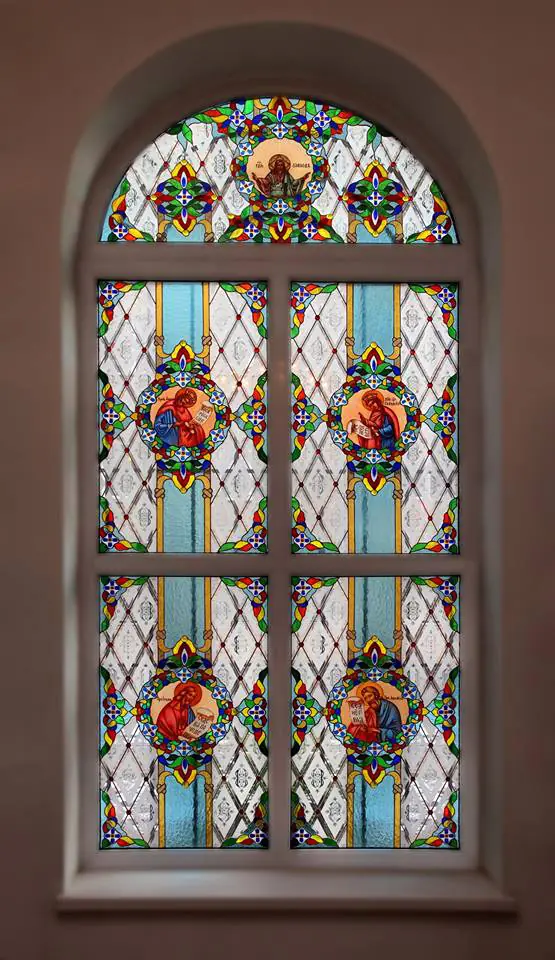
Tiffany stained glass is named after its creator, the famous American artist and stained glass maker Louis Comfort Tiffany (1848-1933). In the late 19th century he developed a new way of assembling stained glass. His innovative approach made it possible to create three-dimensional stained glass, ceilings, domes and lamps. Like stained glass itself, his life and work were many-sided and unusual. Here are some interesting facts.
Family and early years
The name Tiffany is often associated with the jewelry company Tiffany & Co., and the two are indeed linked. Louis Comfort Tiffany was the eldest son of Charles Lewis Tiffany, the founder of the firm, known worldwide for its jewelry, watches and silverware.
As a young man, Louis traveled widely in North Africa, Spain, England, Ireland and France, and studied painting.
Architect, painter, designer
From 1870 to the 1920s Tiffany worked as an architect, painter, and landscape and interior designer. He used many materials: enamel, bronze, ceramics, silver, wood, iron and glass. He designed furniture, carpets, wallpaper, candelabra, clocks and picture frames.
Tiffany's clients included the Queen of England, a Russian prince and the Khedive of Egypt. Between 1880 and 1890 his company made furniture for famous people of the time: Carnegie, Mark Twain, Taylor, Osborne and Vanderbilt. In 1882, at the invitation of US President Chester A. Arthur, Tiffany redecorated several rooms of the White House.
Experiments with glass
Louis loved the power of natural light and the beauty of natural materials. He was convinced that painting on glass could not convey the full beauty of glass, and that lead cames were too coarse for it. So he founded his own glassmaking company, Tiffany Glass Company, and began to experiment.
Tiffany loved working with color and combined different kinds of glass. To get the shade he wanted, he simply layered sheets of glass on top of each other. This led to the invention of Favrile glass (from the Latin for "handmade"), whose structure resembles the patterns of metal, semi-precious stones and enamel.
Iridescent glass was also Tiffany's invention. It is made by sprinkling glass that has not yet cooled with metallic particles, so the sheet shimmers with all the colors of the rainbow and a metallic sheen.
Drapery (folded) glass also became popular thanks to Louis. He made it by deforming a soft sheet of glass and used it as the background of large windows to imitate the foliage of trees and plants.
Tiffany lamps
The whole world knows Tiffany's name thanks to his lampshades, which came about by chance: the first lamps were made from glass offcuts left over from stained glass windows.
The bases of Tiffany lamps were made of metal, sometimes decorated with mosaic. The lamp stands were sold separately, in a great many variants. The very first lamps had an oil reservoir.
Plants and flowers in many shades were the main theme of his lamps. The exact number of lampshades he designed is unknown, but the 1906 catalog listed 300 different models. His lamps were called "hanging bouquets".
Famous works
His best-known work is the Dragonfly lamp, made of more than 1,000 pieces of glass. It was made in different shapes, sizes and colors. The most expensive is the Lotus lamp: in December 1997 it sold at Christie's for $2,807,500, while at the time it was made it cost $750.
One of the largest collections of his glass is held by the Metropolitan Museum of Art in New York.
For Yale University, Tiffany made the Education window (1890). The left side is devoted to Art (Form, Color, Image), the center shows Science (Devotion, Labor, Truth, Research, Intuition), and the right side is devoted to Music (Rhythm, Melody, Harmony, Verse, Voice).
The style Tiffany worked in is known as Art Nouveau.
Personal life
Tiffany's personal life was tragic. Two of his children died in infancy. His first wife, Mary Woodbridge Goddard, died in 1884, and Louis raised their three children on his own. In 1886 he married again, to Louise Wakeman Knox, a distant relative, who bore him more children and died in 1904. In 1910 Tiffany fell seriously ill. Sarah Hanley nursed him back to health and later became his partner and companion.
Tiffany on screen
The underwater Gungan city in The Phantom Menace (Star Wars: Episode I) was inspired by the magic of Tiffany lamps: George Lucas collects them. Another collector is Joel Silver, producer of The Matrix and Sherlock Holmes.
To see how stained glass is made in this technique today, visit the Tiffany stained glass page.