Bevelled mirror tiles: shapes, where to use them and how to order
Dom Stekla
This article in other languages: Українська · Русский
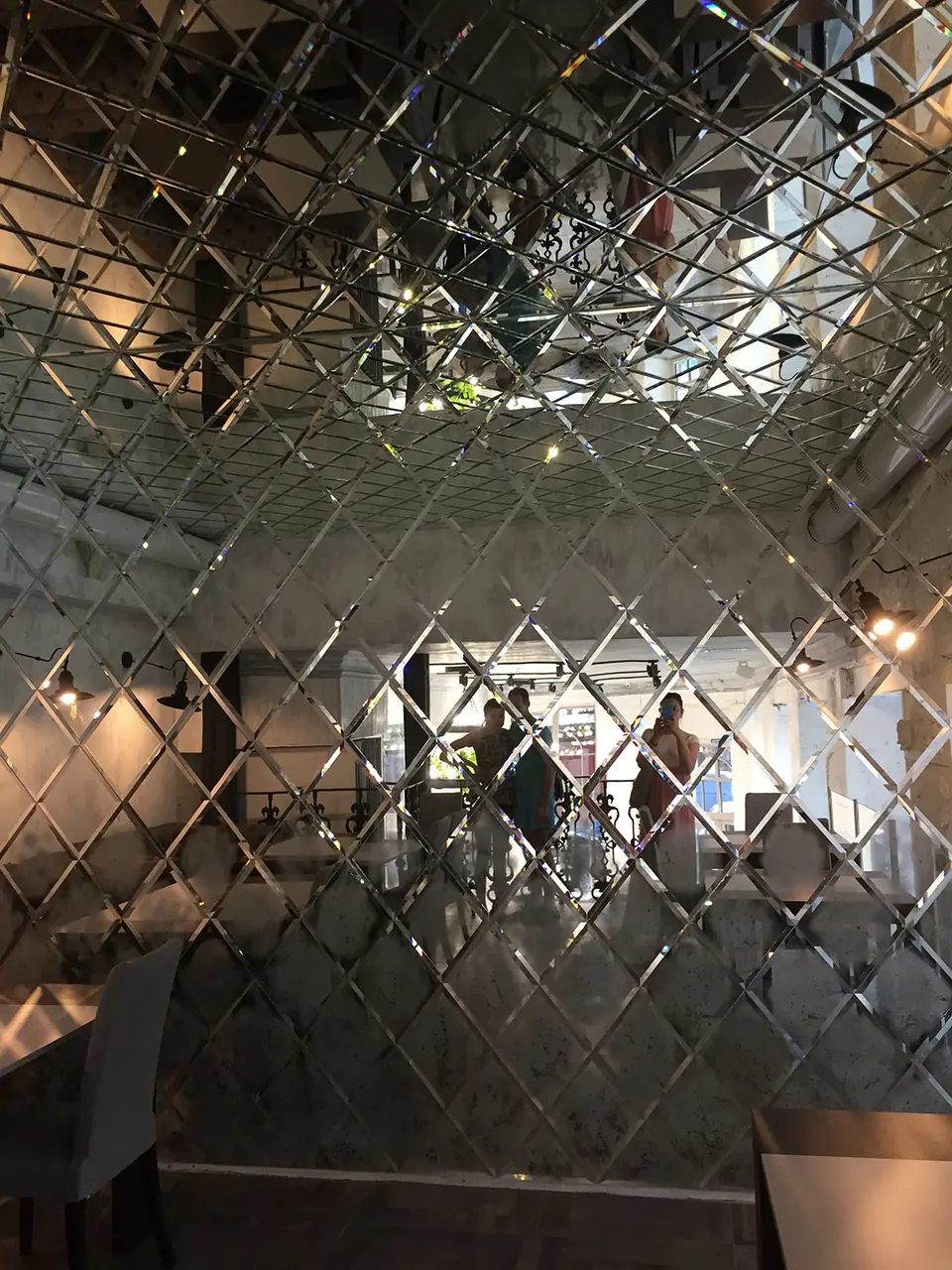
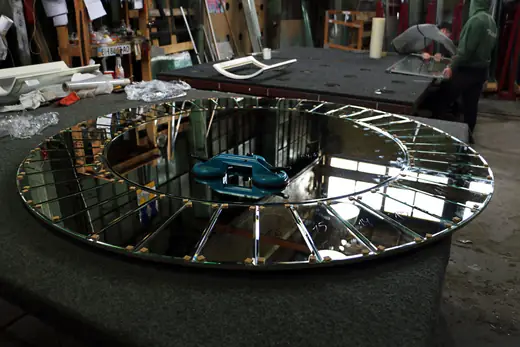
Bevelled mirror tiles are small mirrors with a slanted edge that are assembled into a panel on a wall. Dom Stekla makes these tiles at its own production site at 253 Mykolaivska Road (Prodmash plant, Odesa): it cuts the mirror, bevels the edges and chooses the tile shape and size to suit your wall.
Key takeaways
- A bevel is a slanted edge around each tile. It is what makes the panel look three-dimensional.
- Shapes: diamonds, squares, rectangles, hexagons.
- The tiles are laid in hallways, living rooms and bathrooms, in niches, on wardrobe fronts and doors.
- The tile size does not have to be standard: it is chosen so that there are no narrow offcuts along the wall.
- Glass mirror tiles and self-adhesive plastic tiles are different materials with a different reflection.
- The tiles are not only made but also glued and installed on the wall.
- The price is calculated from the wall area, the shape and the number of tiles.
What bevelled mirror tiles are
An ordinary mirror reflects a room as one flat surface. In a tiled panel every piece has its own slanted edge. These edges catch the light at different angles, so the wall sparkles and looks deeper. That effect is why bevelled tiles are chosen for a hallway or living room, rather than just to see your reflection.
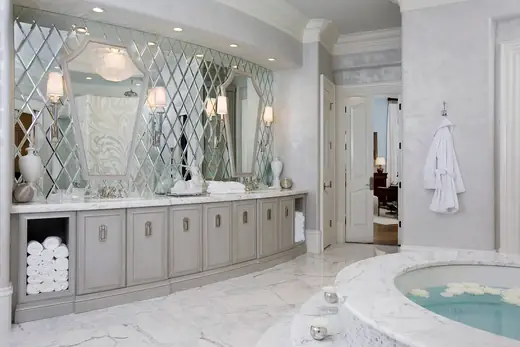
Thin joint lines are visible between the tiles. Together with the bevels they form a pattern: a grid of squares or diamonds, or a honeycomb of hexagons.
What shapes there are
| Shape | How it looks on the wall |
|---|---|
| Square | A calm, even grid that suits a large area |
| Rectangle | A brick pattern or vertical stripes |
| Diamond | A diagonal pattern, a classic for hallways and living rooms |
| Hexagon | A honeycomb, a modern look |
Dom Stekla chooses the tile shape and size to suit your wall. The tiles are cut from a mirror sheet, so the size is not tied to a catalog: it can be set so that no narrow offcuts are left along the edges of the wall.
Where to use mirror tiles
- Hallway and corridor. A narrow space feels wider and gets more light.
- Living room. A panel above the sofa, on the wall behind the TV or in a niche.
- Bathroom. A wall or a niche in mirror tiles.
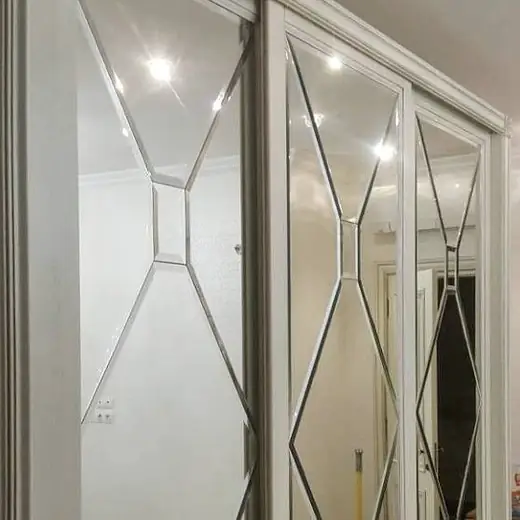
- Wardrobe fronts and doors. Tiles instead of a solid insert.
If you need one large mirror without joints, see the article about a custom mirror. For a kitchen wall people more often choose a glass backsplash.
Glass tiles or self-adhesive ones
Searches often turn up self-adhesive mirror tiles. These are usually plastic tiles with a mirror coating and an adhesive layer. They are light and simple, but plastic is softer than glass: it scratches more easily, and the reflection can look wavy if the wall is uneven.
Bevelled tiles are made from real mirror. The slanted edge on glass gives the facets that catch the light. If the panel should last and look like a mirror rather than a film, people choose glass tiles.
How to prepare the measurements
- Measure the width and height of the wall or niche in several places and write down the smallest value.
- Mark sockets, switches and other places the tiles have to go around.
- Decide which shape you like: square, rectangle, diamond or hexagon.
- Take a photo of the whole wall.
With this information the craftsman will choose the tile size and work out how many tiles you need. Dom Stekla also glues and installs the tiles on the wall itself, so the measurements, fixing and installation are agreed with one craftsman.
What affects the price
- The wall area.
- The tile shape: diamonds and hexagons are harder to cut than squares.
- The size and number of tiles.
- The bevel width and edge finishing.
- Installation on the wall.
- Delivery: Nova Poshta across Ukraine at the carrier's rates, or collection from the production site.
To get the cost calculated, send the wall dimensions and a photo: call (067) 783-40-89 or write on Viber. More details on the mirror tiles page.
Frequently asked questions
What is a bevel on a mirror tile?
It is a slanted edge around the tile. In a panel each facet reflects light at its own angle, so the surface looks three-dimensional.
What shapes do mirror tiles come in?
Diamonds, squares, rectangles, hexagons. The shape and size are chosen to suit your wall.
Can mirror tiles be used in a bathroom?
Yes. Mirror tiles are laid on bathroom walls and in niches.
How do glass bevelled tiles differ from self-adhesive ones?
Self-adhesive tiles are usually plastic: they scratch more easily and can distort the reflection. Bevelled tiles are made from real mirror with a slanted edge.
Do you glue and install the tiles?
Yes. Dom Stekla not only makes mirror tiles but also glues and installs them on the wall.
Can I order tiles in a non-standard size?
Yes. The tiles are cut from a mirror sheet, so the size is chosen for your particular wall.
How much do mirror tiles cost?
The price is calculated from the wall area, the shape, the size and the number of tiles.